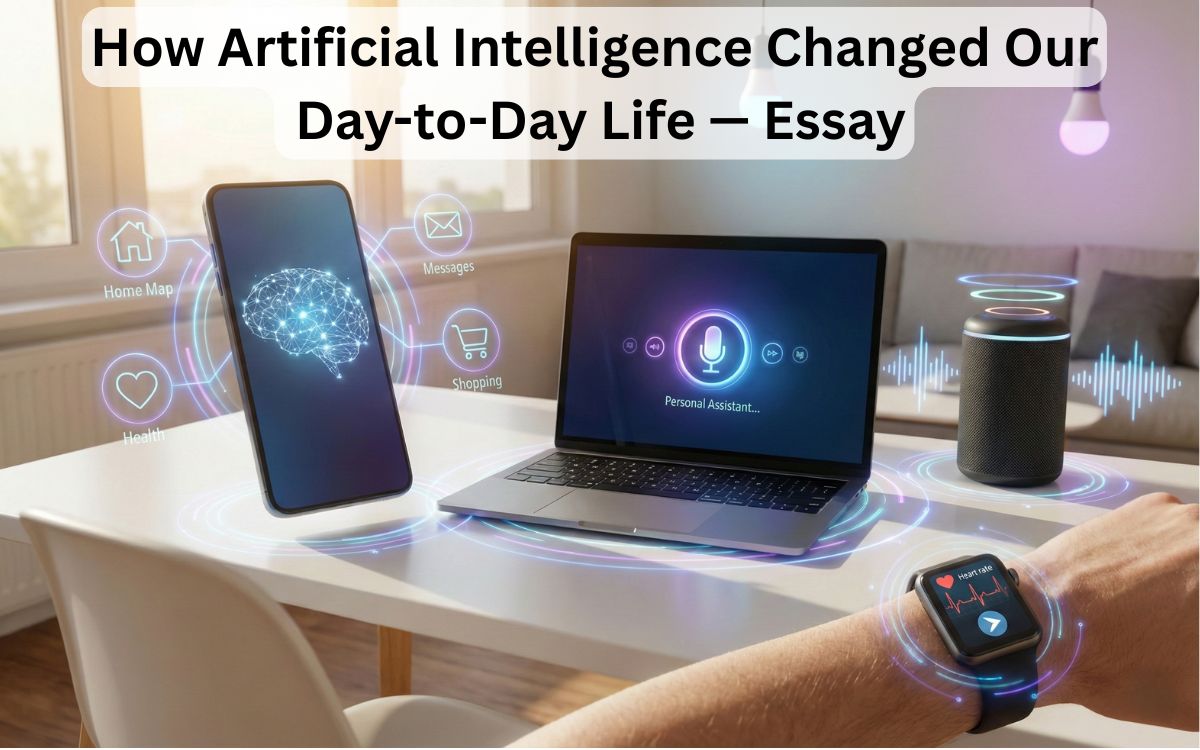
Artificial Intelligence, also known as AI, is no longer something futuristic or limited to science-fiction movies. Today, AI has become a natural part of our daily routine. From the moment we wake up to the moment we go to sleep, AI is quietly working behind the scenes—helping, guiding, predicting, and making life easier. Many people do not realize how deeply AI is woven into modern life because it works silently, solving problems before we even notice them.
In this essay, we will explore how artificial intelligence has transformed our everyday life, the areas where we use it the most, the benefits it brings, and the challenges that come with it.
AI in Our Morning Routine
Most people don’t notice it, but AI starts working the moment we open our eyes. Many of us wake up using smart alarms on our phones that adjust based on our sleep cycle. When we pick up our phone, AI helps organize notifications, filter spam messages, and even predict what apps we want to open.
Apps like weather forecasts, Google Maps, and news feeds all use AI to give personalized information. For example:
- Google Maps predicts traffic and chooses the shortest route to college or office.
- News apps filter topics based on your reading habits.
- Music apps like Spotify or YouTube recommend songs you love—thanks to AI learning your preferences.
These small improvements save time and make mornings more efficient.
AI in Communication & Social Media
AI has transformed the way we communicate. Social media platforms like Instagram, Facebook, and TikTok use AI algorithms to show content that we are most likely to enjoy. When you scroll through Reels or YouTube shorts, AI is studying:
- What you watch
- What you like
- How long you watch each video
- What you skip
This helps the platform create a personalized feed just for you. That is why you feel social media “knows you.”
AI is also used in:
- Auto-correct & Grammarly for writing messages
- Spam filters in email
- Chatbots for customer support
- Voice assistants like Alexa, Siri, and Google Assistant
These AI tools make communication smoother, faster, and more convenient.
AI in Learning and Education
Education is one of the areas where AI has brought massive change. Students today use AI tools knowingly or unknowingly:
- AI tutors explain concepts in simple language
- ChatGPT & Gemini help with homework, essays, and doubts
- Language-learning apps use AI to correct pronunciation
- Online classes use AI for attendance, doubt-solving, and personalized practice
AI allows students to learn at their own pace. For example, if a student is weak in math, AI-based learning platforms give extra practice and explain concepts more slowly.
Teachers also benefit—AI helps check papers, plan lessons, and understand which students need more help.
AI in Shopping and Online Experiences
We don’t realize it, but AI is behind almost every online shopping action:
- Amazon recommends products you may like
- Flipkart suggests similar items
- E-commerce websites use AI to show the best offers
- Chatbots help track orders and solve customer issues
Even grocery apps use AI to predict what you will buy next based on your past orders.
In short:
AI makes online shopping faster, personalized, and highly convenient.
AI in Entertainment and Lifestyle
Whether you watch movies on Netflix or scroll through memes, AI is involved.
Streaming platforms use AI to:
- Recommend movies and shows
- Adjust video quality based on your internet speed
- Create personalized playlists
Gaming companies use AI to build smarter opponents and better graphics.
Fitness apps use AI to:
- Track workouts
- Suggest exercises
- Adjust diet plans
- Monitor heart rate and sleep cycle
In short, AI has entered entertainment, fitness, and personal lifestyle—making everything more smart and personalized.
AI in Work and Productivity
Workplaces have changed dramatically because of AI. Many people use AI without even realizing it:
- Automatic email sorting
- Meeting transcriptions
- AI-generated reports
- Predictive analytics
- Automated reminders
- Smart scheduling tools
AI also reduces boring, repetitive tasks like data entry, sorting files, or organizing emails.
This allows employees to focus on creative and meaningful work.
AI in Banking and Finance
If you have ever received a message like “Suspicious login detected,” that is AI protecting your account.
Banks use AI for:
- Fraud detection
- Loan approvals
- EMI reminders
- Investment advice
- Transaction security
UPI apps like PhonePe, Google Pay, and Paytm use AI to identify fraudulent transactions and ensure safe payments.
Thus, AI has made banking faster, safer, and easier.
AI in Healthcare
Healthcare is one of the biggest beneficiaries of AI. It helps in:
- Detecting diseases earlier
- Analyzing medical reports
- Guiding treatments
- Supporting doctors in surgeries
- Monitoring patient health in real-time
Wearables like smartwatches use AI to track heart rate, oxygen levels, and sleep.
In some cases, AI even helps predict health risks before symptoms appear.
This has revolutionized modern healthcare.
Benefits of AI in Daily Life
Artificial intelligence has brought many advantages:
Convenience
Everything becomes easier—shopping, learning, working, commuting, or entertainment.
Personalization|
Your apps know what you like and adjust to your needs.
Speed
AI performs tasks faster than humans.
Accuracy
AI reduces human errors in calculations, recommendations, and predictions.
Safety
AI detects fraud, filters harmful content, and assists in medical diagnosis.
Challenges and Concerns of AI
Despite its benefits, AI also brings challenges:
❌ Job Replacement
Some repetitive jobs may disappear because AI can perform them better.
❌ Privacy Issues
Apps collect data to understand habits, raising privacy concerns.
❌ Overdependence
People may become too dependent on AI tools.
❌ Misinformation
AI-generated content must be used responsibly.
The key is balance—using AI smartly without losing human skills.
Conclusion — AI Has Become a Silent Partner in Our Life
Artificial Intelligence has transformed modern life in ways we never imagined. In our daily routine—whether we study, work, shop, travel, watch content, or communicate—AI quietly supports us. It saves time, increases convenience, improves security, and gives us personalized experiences.
At the same time, we must be responsible users. AI is powerful, but human creativity, judgment, and ethics are even more important.
In short:
AI has not just changed our daily life — it has become part of our daily life.
And as technology continues to evolve, AI will make the future even smarter, smoother, and more connected.